
2026-05-11 · paper
When do brains (and large language models) really track the world?
Work in progress. I’ll keep adding to this as I go; for now it’s just a starting frame.
In this post, which may well grow into a small series, I want to walk slowly through two papers I’ve put up recently, Between Interface and Truth: Multi-Task Selection Drives Ecologically Veridical Perception on EcoEvoRxiv and Task Ecologies and the Evolution of World-Tracking Representations in Large Language Models on arXiv. Those papers are written for specialists in evolutionary modelling and in machine learning, the kind of reader who wants the formal setup before deciding whether the argument is worth chewing on. They do that job, I hope. They also fall short of engaging anyone who isn’t already in one of those rooms, which has always bothered me a little. There are ideas in this corner of cognitive science that I think any curious person could enjoy, if they’re laid out gently enough.
So that’s what I’ll try here. A long, slow explanation, of the kind I’d give to a curious friend who’s patient enough to listen :-) Drawings will come too; words alone aren’t going to do the story justice.
Let’s begin from the very beginning.
The question
Here’s a question that’s been bothering me for a while.
When a brain (or any learning system, biological or artificial) builds an internal picture of the world, does that picture have anything to do with the world it claims to picture?
Put it another way. When you see a coffee cup on the table, your brain is doing a great deal of work to produce the sensation “coffee cup on the table.” That sensation is useful. It correlates well enough with reality that you can pick the cup up without spilling. But is it true? Is the brain’s internal picture of the world the world’s actual structure, or is it more like a desktop icon: a useful little thing on a screen that bears no real resemblance to the file system it stands for?
The desktop answer
This isn’t a new question. The philosopher Donald Hoffman has been arguing for the desktop-icon answer for a long time, and he has mathematical results to back it up. Roughly: if you simulate organisms whose only job is to survive in an environment, and you let the most successful ones reproduce, what you select for is fitness. Fitness alone. And fitness, Hoffman shows, can be maximised by perceptions that bear no resemblance to the underlying world, as long as those perceptions correlate well enough with what helps the organism live. He calls the result Fitness Beats Truth.
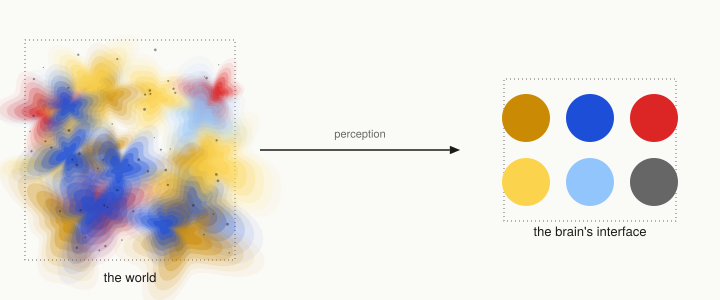
Left, the world as it actually is: continuous, overlapping, rugged, with no obvious boundaries. Right, the brain’s interface: a clean set of discrete tokens. The arrow between them is perception, the work of cutting the continuous mess on the left into the categorical thing on the right. The two panels share little visually, and that’s the point.
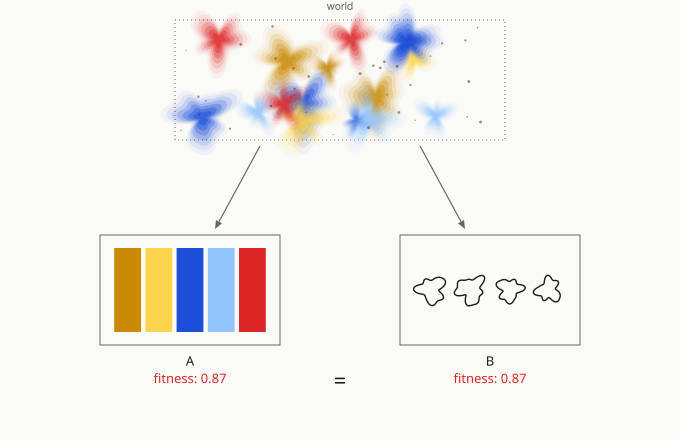
Same world (top), two organisms A and B that extract different features of it. A only sees colour. B only sees shape. Both perceptions yield the same fitness, so selection alone has no way to tell them apart.
That’s a powerful claim, and one I find unsettling. If Hoffman is right, then the things you see, hear, and feel in your day-to-day life have almost certainly nothing to do with the actual structure of reality. Your conscious experience is an interface. The world underneath is something else entirely, and selection had no particular reason to show it to you.
Why it bothered me
That bothered me, because I think there are good reasons to believe brains do, in fact, track something about the world. We do physics. We build machines that work. The desktop metaphor doesn’t quite explain that.
So I started picking at the assumption. And one assumption I found, sitting underneath Hoffman’s argument, looked suspicious to me.
The single-task assumption
The assumption is that there is one task. One fitness function. One thing the organism is being selected for.
But organisms do hundreds of things at the same time. So do large language models.
Imagine forging a Picasso. Drag the slider from 1 to 6 tasks: at one task (“the canvas dimensions match”), the forger can hand in a blank canvas and walk away. As more tasks come in at once (paper, composition, drawing, brushwork, details), the forger is forced to track the original, all the way down. Hoffman’s single-task assumption puts perception in the first situation; real organisms (and language models) live in the second.
Where we go next
Next time I’ll show why that single assumption changes the conclusion, and what happens when you let the task ecology widen.
For now, here’s where we’ve arrived. We’ve put a hard question on the table (does perception track the world?), heard the strongest counter (Hoffman’s Fitness Beats Truth: perception as interface, the world underneath hidden by selection), and found the seam in that argument: the assumption that there’s only one task. The rest of the series will pull on that seam.